FRP and fiberglass are related but not identical: fiberglass is glass fibers alone or as the reinforcement inside a composite, while FRP (fiber-reinforced polymer/plastic) is the broader material category that can use glass, carbon, aramid, or basalt fibers set in a resin matrix. Every fiberglass product is technically a type of FRP, but not every FRP product is fiberglass. For pipes specifically, the two terms are used almost interchangeably in the industry because nearly all commercial FRP pipe is glass-fiber reinforced — but knowing the distinction matters when you're comparing specs, reading a standard, or writing a purchase order.
Direct Answer
Fiberglass is a fiber. FRP is a finished composite material. Fiberglass refers specifically to glass fibers made by melt-spinning molten glass. FRP describes any polymer resin reinforced with fibers — glass, carbon, aramid, or basalt — so fiberglass is one raw ingredient that FRP is built from, not a separate competing material.
What Actually Separates FRP From Fiberglass
The confusion exists because manufacturers, buyers, and even engineers routinely use "fiberglass" as shorthand for any glass-reinforced composite product, whether that's a pipe, a panel, or a boat hull. Technically, though, the two words describe different layers of the same material system.
Fiberglass is made by melting silica sand or limestone at high temperature and extruding it through fine orifices called bushings to form continuous filaments. Those filaments are coated, bundled into rovings, and either used loose (as insulation) or woven into fabric. On its own, glass fiber is brittle and has almost no structural use — it needs a binding matrix to become load-bearing.
FRP is that finished, load-bearing result: fibers embedded in a thermosetting or thermoplastic resin such as polyester, vinyl ester, or epoxy. The resin transfers load between fibers and protects them from moisture and chemical attack, while the fibers supply the tensile strength. Because the fiber type isn't fixed, "FRP" covers a wider family of materials than "fiberglass" ever does.
| Attribute |
Fiberglass |
FRP (general) |
| What it is |
Glass fiber only, or glass fiber as the reinforcement |
Any fiber (glass, carbon, aramid, basalt) set in a resin matrix |
| Typical tensile strength |
350–600 MPa (standard E-glass laminate) |
800–1,200 MPa for carbon-rich laminates |
| Relative weight |
Baseline |
Roughly 35% lighter for equal thickness in carbon/hybrid layups |
| Common resins |
Polyester, vinyl ester, epoxy |
Same resin options, matched to fiber and service condition |
| Where the term is used |
Boats, tubs, insulation, general consumer products |
Structural profiles, pipe, grating, rebar, aerospace parts |
800–1,200
MPa tensile strength for carbon-rich FRP laminates, based on a 2024 meta-analysis of 790 material tests — roughly double the 350–600 MPa typical of standard E-glass fiberglass laminates at equal thickness.
Where the naming gets confusing
Some suppliers use "GRP" (glass-reinforced plastic) specifically to mean glass-fiber FRP, reserving "FRP" for non-glass or mixed-fiber products. Others use FRP and GRP as pure synonyms. When you're sourcing pipe, fittings, or panels, don't assume the label tells you the fiber type — check the spec sheet or resin/fiber callout in the product datasheet instead.
Why FRP Pipe Specifically Uses Glass Fiber
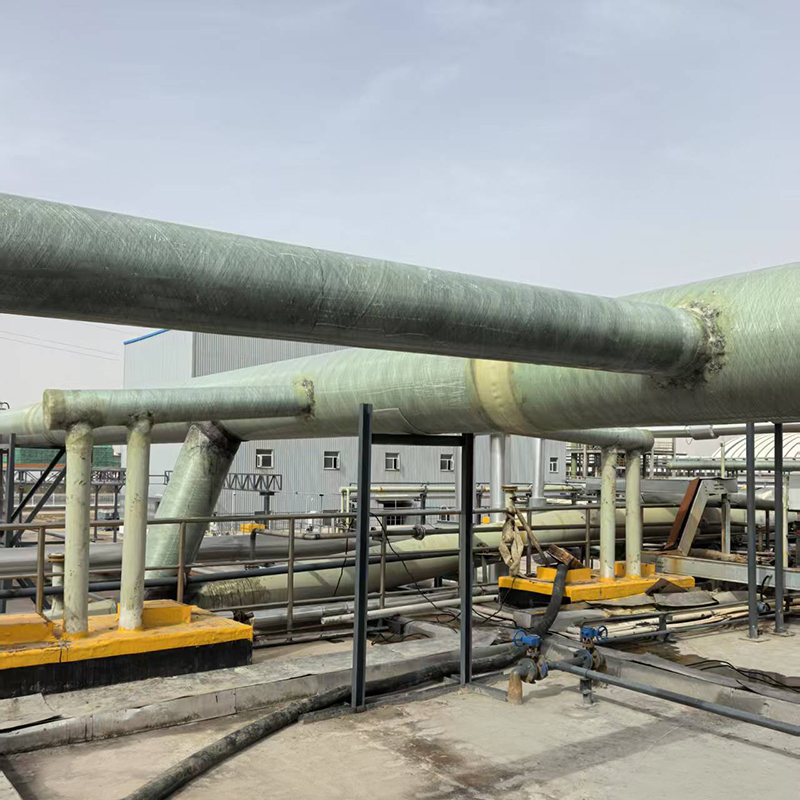
Almost all commercial FRP pipe is glass-fiber reinforced rather than carbon or aramid, which is why "FRP pipe" and "fiberglass pipe" are treated as the same product in catalogs, standards, and RFQs. The reason is cost and corrosion performance, not strength: glass fiber gives more than enough tensile capacity for pressure and gravity piping at a fraction of the cost of carbon fiber, and the glass itself is chemically inert to most acids, alkalis, and saltwater when properly wetted out in resin.
That's also why the two governing manufacturing methods for FRP pipe are built around glass roving specifically: filament winding, where continuous glass strands are wound onto a rotating mandrel at controlled angles (typically 54–56 degrees for pressure pipe), and centrifugal casting, where chopped glass and resin are spun inside a mold to form a dense, uniform wall. Both processes are engineered around glass fiber's handling characteristics.
Reading an FRP pipe spec sheet without confusion
- "Type" refers to laminate construction, not fiber material. ASME NM.2 classifies FRP pipe as Type I, II, or III laminate, which describes contact-molded versus filament-wound construction — this has nothing to do with whether the fiber is glass or something else.
- Pressure class and stiffness class are separate ratings. A pipe can carry a high pressure class but a low stiffness class, or vice versa; don't assume one implies the other.
- Liner resin and structural resin can differ. Many pipes use a resin-rich corrosion liner (with a C-veil or nexus layer) on the inside bore that's chemically matched to the fluid, while the outer structural wall uses a different, cheaper resin for strength.
FRP Pipe Standards and Working Limits Engineers Actually Reference
FRP pipe is manufactured and tested against a specific set of ASTM, AWWA, and ASME standards, and the standard used determines how the pipe is rated and what documentation ships with it.
Governing Standards
Filament-wound pipe ASTM D2996
Centrifugally cast pipe ASTM D2997
Sewer & industrial pressure pipe ASTM D3754
Machine-made flanges ASTM D4024
Fiberglass pressure pipe (O-ring joints) AWWA C950
Formal pipe stress / thermosetting-resin systems ASME NM.2 / NM.3
Process piping design code ASME B31.3
Working limits vary by resin system and manufacturer, but the typical ranges specifiers plan around are:
| Parameter |
Typical range |
| Standard pressure rating |
Up to roughly 60 bar (≈870 psi) at ambient temperature for standard FRP; glass-reinforced epoxy (GRE) piping can reach ≈400 bar in specialty service |
| Diameter range |
15 mm to 4,000 mm, with 50–2,500 mm being the common commercial range |
| Polyester resin liner |
Roughly 60–80°C continuous service |
| Vinyl ester resin liner |
Roughly 100–150°C continuous service |
| Epoxy / phenolic resin liner |
Higher end of the range; specialty formulations handle hot acids up to roughly 200–250°C |
| Pressure derating at elevated temperature |
Example: one major manufacturer derates a 200 psig-rated pipe by a factor of 0.73 at 210°F, with linear interpolation between 150–210°F |
One detail that trips up engineers moving from steel to FRP: thermal expansion analysis works differently. On a steel line, you evaluate expansion across the full range from minimum to maximum design temperature. On FRP, ASME NM.2 guidance splits that range at the installation temperature (commonly assumed to be 70°F/21°C) because the pipe's residual stress state changes at that reference point — using the steel-style single-range calculation on FRP can understate stress on one side of that split.
Where FRP Pipe Outperforms Steel and Concrete in Practice
The case for FRP pipe over metal or concrete alternatives comes down to three measurable factors: weight, corrosion life, and installed cost over time — not just upfront material price.
| Factor |
FRP pipe |
Steel / concrete |
| Relative weight |
~20% the weight of steel, ~10% the weight of reinforced concrete |
Baseline (heavier, needs cranes and thicker supports) |
| Corrosion behavior |
Resin-lined bore resists acids, alkalis, and saltwater without coatings |
Requires cathodic protection, coatings, or cement lining to resist the same fluids |
| Typical service life |
Often exceeds 30–50 years with routine maintenance |
Frequently shorter in corrosive service without active protection |
| Installation |
Long continuous sections (tens of meters) reduce joint count and leak paths |
More field joints and welding required for equivalent runs |
| Electrical / thermal behavior |
Non-conductive, good thermal insulator |
Conductive; needs separate insulation for thermal control |
That weight difference isn't just a handling convenience. At roughly a fifth the weight of comparable steel pipe, FRP lines can often be positioned with smaller cranes or manual lifts, which matters directly on remote sites, offshore platforms, and retrofit projects where crane access is limited or expensive to mobilize.
Industries where this combination matters most
- Chemical and petrochemical processing — corrosive acid and alkali transfer lines where metal would need constant coating maintenance or cathodic protection.
- Desalination and water treatment — high-salinity intake and brine lines where steel corrodes quickly without expensive alloy upgrades.
- Municipal sewer and wastewater — gravity and pressure sewer lines where hydrogen sulfide gas attacks concrete and steel from the inside.
- Offshore oil and gas — firewater, produced water, and cooling lines where weight reduction directly affects platform load and lifting costs.
- Power generation — flue gas desulfurization ductwork and cooling water systems exposed to acidic scrubber byproducts.
What to Check Before Specifying FRP Pipe for a Project
Getting a working FRP pipe system right comes down to matching the resin to the actual fluid and temperature, not just ordering by diameter and pressure class.
- Confirm the resin against your actual chemical list, not a general category. "Chemical resistant" isn't a spec — cross-reference the resin manufacturer's chemical resistance guide against every fluid, including cleaning and CIP chemicals, the line will see.
- Check the temperature at the pipe wall, not just the bulk fluid temperature. Surface temperature at pumps, valves, or heat-traced sections can exceed bulk fluid temperature and push the pipe past its resin's rated limit.
- Verify the design temperature threshold for formal stress analysis. Industry guidance flags design temperatures at or above 150°F (65°C) as needing a formal pipe stress program under ASME B31.3 and ASME NM.2, rather than relying on standard support spacing tables alone.
- Ask for batch test data, not just a datasheet. Reputable manufacturers hydrostatic-test production samples and can supply mechanical property and dimensional test results tied to your specific order, not just catalog averages.
- Plan joints and supports as part of the design, not an afterthought. Bell-and-spigot adhesive-bonded joints, flanged connections, and support spacing all affect long-term performance, and FRP support guidance differs from steel piping practice.
The short version
Fiberglass is the glass fiber itself; FRP is the finished composite that fiber becomes once it's set in resin. For pipe, the distinction rarely changes your buying decision, since nearly all FRP pipe on the market is glass-reinforced — but it changes how you should read a datasheet.
When specifying, match the resin to your fluid and real operating temperature, confirm which ASTM or AWWA standard the pipe is certified to, and get batch-specific test data before you order — that's what actually determines whether the pipe performs for the 30-to-50-year service life the material is capable of.



 Tiếng Việt
 عربى
عربى Get a quote

 Tel: +86 0515-86302568
  E-mail:
  Add: No. 11, Xingwang Road, Jianyang Town, Jianhu County, Jiangsu Province, China