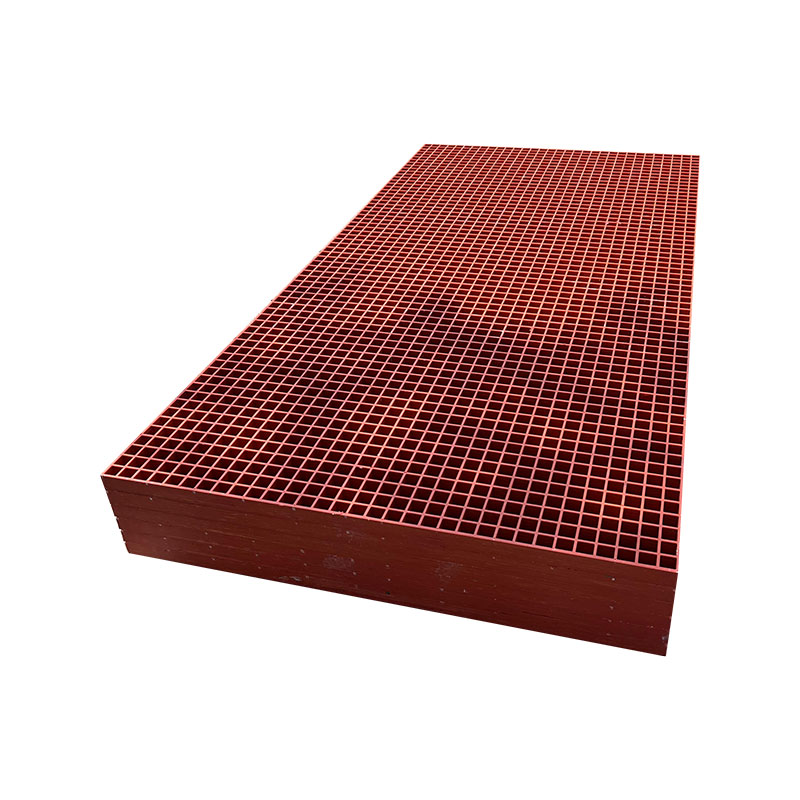
FRP molded grating is a one-piece fiberglass reinforced plastic panel manufactured by simultaneously weaving continuous glass fiber rovings in both directions through a mold and saturating them with thermosetting resin — creating a bidirectional, interlocked grid structure with equal strength in both the longitudinal and transverse directions. This isotropic load distribution, combined with inherent corrosion resistance, light weight, and non-conductivity, makes FRP molded grating the standard choice for walkways, platforms, trenches, and flooring in chemical, water treatment, marine, and food processing environments where steel grating would corrode and aluminum grating would be inadequate.
The global FRP grating market was valued at approximately $1.4 billion in 2023 and is growing at over 5% annually, driven by infrastructure replacement of corroding steel in aggressive chemical environments, increasing offshore platform construction, and expanding water and wastewater treatment capacity. This guide covers everything specifiers, procurement engineers, and facility managers need to make informed FRP molded grating selections — from manufacturing and load performance to resin compatibility and installation.
How FRP Molded Grating Is Manufactured
Understanding the manufacturing process explains both the performance advantages and the dimensional limitations of molded FRP grating compared to its pultruded alternative.
The Open Mold Process
Molded FRP grating is produced in a matched metal or composite open mold. Continuous glass fiber rovings are woven manually or by machine through the mold's pin array — alternating over and under in both the warp (longitudinal) and fill (transverse) directions, creating an interlocked weave pattern. This continuous fiber weaving is what gives molded grating its bidirectional strength characteristic.
After the fiber weaving is complete, liquid thermosetting resin (polyester, vinyl ester, or phenolic) is poured over the fiber bed and drawn down through the structure by vacuum assistance or simply by gravity and squeegee application. The mold is then closed under pressure, and the resin is cured — either at ambient temperature for standard grades or in a heated press for premium grades. The result is a single-piece panel where every bar junction is molecularly bonded rather than welded or mechanically fastened. Bar junction integrity is the defining structural advantage of molded grating — junctions cannot loosen, corrode, or separate over service life.
Panel Dimensions and Standard Sizes
Molded grating is produced in standard panel sizes — the most common being 1.2m × 3.6m (4ft × 12ft) and 1.0m × 2.0m, though manufacturers offer various standard sizes. Unlike pultruded grating which can be produced in continuous lengths, molded grating is limited to the mold dimensions. Custom mold sizes are available for large projects but carry significant tooling costs. Standard panel thickness ranges from 25mm (1 inch) to 50mm (2 inches), with 38mm (1.5 inch) the most widely used structural depth for walkway applications.
FRP Molded Grating vs. Pultruded Grating: Key Differences
FRP grating is available in two fundamentally different manufacturing formats — molded and pultruded — and the choice between them has significant implications for structural performance, chemical resistance, cost, and installation practicality. Specifiers must understand these differences to make the correct selection.
Direct comparison of FRP molded and pultruded grating across key structural, chemical, and practical performance criteria
| Property |
Molded FRP Grating |
Pultruded FRP Grating |
| Load direction |
Equal in both directions (isotropic) |
Primarily longitudinal (anisotropic) |
| Typical span capacity |
Up to ~1.2m for 38mm depth |
Up to ~2.0m for equivalent depth |
| Glass fiber content |
25–35% by weight |
55–65% by weight |
| Resin content |
Higher — better chemical barrier |
Lower — less chemical resistance |
| Bar junction |
Continuous interlocked — integral |
Locked rod or adhesive — separate assembly |
| Panel size flexibility |
Limited to mold dimensions |
Continuous production — custom lengths |
| Cost at equivalent load |
Generally lower |
Generally higher |
| Best application |
Chemical environments, short spans, multi-directional loads |
Long spans, structural platforms, heavy concentrated loads |
The higher resin content of molded grating — compared to pultruded — is particularly significant in chemical service. The resin matrix encapsulates the glass fibers more completely, reducing the exposed glass fiber surface that acids and alkalis can attack. In pH environments below 2 or above 12, molded grating with vinyl ester resin significantly outperforms pultruded grating at equivalent cost.
Resin Systems: Matching Chemistry to Environment
Resin selection is the most critical specification decision for FRP molded grating in chemical service. The resin matrix determines the grating's resistance to specific chemicals, its maximum service temperature, UV stability, and fire performance. Three resin families dominate the FRP grating market.
Orthophthalic Polyester Resin
Orthophthalic polyester is the entry-level resin for FRP grating — lowest cost, adequate for non-chemical environments such as general construction platforms, recreational facilities, and architectural applications. Chemical resistance is limited: orthophthalic polyester is not recommended for continuous exposure to acids, alkalis, solvents, or oxidizing chemicals. Maximum service temperature is approximately 65°C (150°F). It is suitable for applications where corrosion protection is primarily against atmospheric moisture and salt air rather than direct chemical exposure.
Isophthalic Polyester Resin
Isophthalic polyester provides significantly improved chemical resistance over orthophthalic grades, particularly against dilute acids, salt solutions, and hydrocarbon fuels. Maximum service temperature increases to approximately 80°C (176°F). Isophthalic grating is the appropriate standard grade for water and wastewater treatment plants, coastal platforms, and facilities using dilute chemical processes. It represents the best value choice for moderate chemical environments.
Vinyl Ester Resin
Vinyl ester resin is the premium choice for severe chemical service. Its molecular structure — with reactive sites only at the chain ends rather than distributed along the backbone as in polyester — provides significantly better resistance to hydrolysis and chemical attack. Vinyl ester grating is specified for direct exposure to concentrated acids (sulfuric, hydrochloric, nitric below 60°C), concentrated caustics (sodium hydroxide, potassium hydroxide), oxidizing chemicals, and solvents. Maximum service temperature reaches 100°C (212°F) for standard grades and higher for specially formulated high-temperature systems. Cost premium over isophthalic polyester is typically 25–40%.
Phenolic Resin
Phenolic resin FRP grating is specified exclusively for fire-critical applications — it provides outstanding inherent fire resistance with flame spread index below 25 and smoke development below 50 per ASTM E84, meeting the most demanding fire codes for offshore platforms, mining, and transit applications without the need for fire-retardant additives. Chemical resistance is good but not as broad as vinyl ester. Phenolic grating is significantly more expensive and requires more care during fabrication and cutting due to its harder, more brittle matrix.
Mesh Configurations and Bar Profiles
FRP molded grating is available in multiple mesh opening sizes and bar depths. The mesh configuration affects load capacity, surface drainage, foot traction, and suitability for specific applications.
Standard FRP molded grating configurations with typical load capacity and recommended applications
| Mesh Opening |
Bar Depth (Thickness) |
Typical Load at 1.2m Span |
Open Area % |
Primary Applications |
| 38mm × 38mm (1.5" × 1.5") |
25mm (1") |
~1.0 kN/m² uniform |
~67% |
Light-duty walkways, drainage covers, stair treads |
| 38mm × 38mm (1.5" × 1.5") |
38mm (1.5") |
~2.4 kN/m² uniform |
~67% |
Standard walkways, platforms, mezzanines |
| 38mm × 38mm (1.5" × 1.5") |
50mm (2") |
~4.8 kN/m² uniform |
~67% |
Heavy-duty platforms, vehicle traffic areas |
| 25mm × 25mm (1" × 1") |
38mm (1.5") |
~2.4 kN/m² uniform |
~51% |
Small wheel carts, heel-safe, tool drop prevention |
| 51mm × 51mm (2" × 2") |
38mm (1.5") |
~2.2 kN/m² uniform |
~75% |
Maximum drainage, ventilation floors, fish processing |
The 38mm × 38mm mesh with 38mm depth is the most widely specified configuration, providing the best balance of load capacity, drainage, and foot comfort for standard industrial walkway applications. Where women's heeled footwear or small wheel equipment is anticipated, the 25mm mesh eliminates heel entrapment concerns. Larger 51mm meshes maximize drainage flow but provide lower load capacity per unit weight and are not heel-safe without a close-mesh overlay.
Surface Finishes and Anti-Slip Options
The top surface of FRP molded grating can be specified in several configurations depending on the slip resistance, wear resistance, and process hygiene requirements of the application.
Gritted Anti-Slip Surface
The most common anti-slip finish — aluminum oxide or silicon carbide grit is applied to the top surface of the grating during manufacturing and bonded into the resin matrix. Grit size is typically 24 grit for standard applications or 36 grit for less aggressive environments. Gritted surfaces provide coefficient of friction values of 0.8 or higher (wet), meeting or exceeding OSHA and building code requirements for walkway slip resistance. The grit is permanently embedded — it does not wash off or wear away in normal service, unlike applied anti-slip coatings.
Concave Top Surface (Meniscus)
Some molded grating products feature a concave meniscus top surface where each bar's top has a shallow curved depression that channels liquid away from the walking surface. This provides good slip resistance without grit — preferred in food processing and pharmaceutical facilities where grit particles could contaminate products and where surface cleanability is critical. The smooth concave surface is also easier to clean than a gritted surface in hygiene-sensitive applications.
Smooth Top with Resin-Rich Surface
Smooth-top grating is specified where the grating is used as a structural element not requiring walk-on slip resistance — for example, as an equipment support platform beneath machinery, as a buried drainage substrate, or where a separate floor covering will be applied. The smooth resin-rich surface maximizes chemical barrier performance by ensuring no exposed glass fiber on the walking surface.
Load Capacity and Structural Design Considerations
Structural adequacy of FRP molded grating depends on four variables that must be evaluated together: panel depth (thickness), span between supports, applied load type (uniform or concentrated), and acceptable deflection limit.
Uniform vs. Concentrated Load
Manufacturer load tables provide both uniform load (UDL) and concentrated load (single point) data for each grating type and span combination. For personnel walkways, OSHA 1910.23 requires a minimum live load of 4.8 kN/m² (100 psf) for walking surfaces — a standard that 38mm-depth molded grating meets on spans up to approximately 900–1,000mm. For spans approaching 1,200mm, 50mm-depth grating is typically required. Concentrated load data is critical for applications where heavy equipment, loaded fork trucks, or rolling loads are anticipated.
Deflection Limits
Unlike steel grating, FRP grating has a lower elastic modulus — it deflects more under equivalent load. The industry-accepted deflection limit for FRP walkway grating is span/200 under full design load (e.g., 6mm maximum deflection for a 1,200mm span). This limit ensures the grating feels rigid underfoot and prevents excessive flex that could loosen fasteners or cause edge-bearing failure over time. Always verify deflection against this criterion, not just load capacity — deflection typically governs the design of FRP grating in the 900–1,200mm span range.
Support Structure Requirements
FRP molded grating requires continuous bearing support along its perimeter. Edge supports must provide a bearing width of at least 25mm (1 inch) on all sides — inadequate bearing width causes edge stress concentrations that can fracture the outer bars of the panel. For heavy loads or spans approaching maximum rated values, intermediate support bars at mid-span are recommended to halve the effective span and increase load capacity dramatically.
Chemical Resistance Guide: Selecting the Right Resin
Chemical resistance is the primary reason most industrial facilities specify FRP grating over steel. However, not all FRP grating resists all chemicals — the resin selection must be matched to the specific chemicals, concentrations, and temperatures present in the operating environment.
The following table provides a general chemical resistance guide. Always verify with the specific manufacturer's chemical resistance data for your exact chemical, concentration, and temperature conditions before finalizing specification.
General chemical resistance of FRP grating resin systems (R = Recommended, C = Conditional use, NR = Not Recommended)
| Chemical / Environment |
Ortho Polyester |
Iso Polyester |
Vinyl Ester |
| Seawater / salt spray |
C |
R |
R |
| Dilute sulfuric acid (≤10%) |
NR |
C |
R |
| Concentrated sulfuric acid (>50%) |
NR |
NR |
C (consult manufacturer) |
| Hydrochloric acid (≤20%) |
NR |
C |
R |
| Sodium hydroxide (≤25%) |
NR |
C |
R |
| Chlorine / bleach solutions |
NR |
C |
R |
| Wastewater / sewage |
C |
R |
R |
| Petroleum fuels / hydrocarbons |
C |
R |
R |
| Ketones / esters (solvents) |
NR |
NR |
C (consult manufacturer) |
Colors, UV Stability, and Identification
FRP molded grating is available in a wide range of standard colors — the most common being safety yellow, gray, green, red, and beige — with custom colors available on order minimums. Color is integral to the resin matrix, not painted or coated, so color does not peel, chip, or require repainting over the product's service life.
Color serves important functional roles in industrial facilities: safety yellow for walkways and hazard identification areas, red for fire equipment access paths, green for chemical areas requiring color coding, and gray or beige for general architectural applications. OSHA and facility safety standards often require specific color designations for walking surfaces near hazards.
UV stability varies by resin type. Standard polyester resins chalk and fade under prolonged UV exposure. For outdoor applications requiring color stability, specify UV-inhibited resin systems or request a UV-stable surface veil layer — a thin fiberglass tissue layer saturated with UV-stabilized resin applied to all exposed surfaces during manufacture. UV-stabilized grating maintains appearance and surface resin integrity significantly longer in outdoor service, reducing the risk of glass fiber "blooming" (surface fiber exposure) that can cause skin irritation and indicates UV degradation of the surface layer.
Cutting, Fabricating, and Installing FRP Molded Grating
FRP molded grating can be cut to any size in the field or pre-fabricated in the shop. Unlike steel grating, no hot work or welding is required — making FRP installation feasible in live chemical plants, offshore platforms, and other hot-work-restricted environments.
Cutting Methods
- Diamond-tipped circular saw blade: The preferred method for clean, precise cuts with minimal dust. Use a fine-toothed diamond blade (80+ teeth) at moderate RPM. A masonry diamond blade is an acceptable field alternative.
- Abrasive cut-off wheel: Faster than diamond blade but produces more dust and a rougher edge. Acceptable for non-cosmetic cuts in field applications.
- Jigsaw with carbide blade: Used for curved cuts and penetration cutouts around pipes and columns. Slower but provides flexibility for complex shapes.
All cut edges must be sealed with catalyzed resin after cutting to prevent moisture ingress into exposed glass fiber ends and to prevent glass fiber skin irritation during handling. Edge sealing is mandatory in chemical environments where cut edges would otherwise expose the internal glass fiber to chemical attack. Apply two coats of compatible gel coat or resin with a brush, allowing the first coat to cure before the second application.
Fastening and Clip Systems
FRP molded grating is secured to support structures using FRP or stainless steel hold-down clips designed to grip the grating bar and bolt to the supporting structure. Standard clip spacing is one clip per 300mm (12 inches) of panel perimeter and at all intermediate support points. Do not use carbon steel fasteners in chemical environments — galvanic corrosion will occur within months. Use FRP clips with 316 stainless steel hardware for most environments, or all-FRP fasteners in the most aggressive chemical service.
Standards, Testing, and Certifications for FRP Molded Grating
Specifying FRP grating for regulated industries requires verifying compliance with applicable standards. The key standards vary by application and geography:
- ASTM E985: Standard Specification for Permanent Metal Railing Systems and Rails for Buildings — adopted as a reference for FRP grating structural requirements in North American building codes.
- ASTM E84 (NFPA 255): Standard Test Method for Surface Burning Characteristics — provides flame spread index (FSI) and smoke development index (SDI). Most specifications require FSI ≤25 and SDI ≤450 for industrial platforms; offshore and transit applications require more stringent limits.
- BS EN 13706: European specification for pultruded FRP profiles — while technically for pultruded products, its testing methodologies are frequently referenced for molded grating qualification in European projects.
- OSHA 1910.23 / 1926.502: U.S. workplace walking-working surface standards — specify minimum load capacity (4.8 kN/m²), slip resistance (minimum 0.5 static coefficient of friction), and opening size requirements (maximum 19mm opening in any direction for heel protection) for industrial walkways.
- NORSOK M-650 / ISO 14692: Norwegian offshore standards for FRP components used on offshore platforms — among the most demanding qualification frameworks for FRP products, requiring comprehensive material testing and third-party verification.
- UL 94 V-0 flame rating: Relevant for FRP grating used in electrical equipment enclosures or areas requiring UL-listed materials for electrical safety compliance.
Total Cost of Ownership: FRP Molded Grating vs. Steel Grating
FRP molded grating typically has a higher initial purchase price than hot-dip galvanized or painted steel grating of equivalent load capacity. However, total cost of ownership over a 20–30 year service life in corrosive environments consistently favors FRP, driven by three factors:
- Zero maintenance cost: FRP molded grating requires no painting, galvanizing renewal, or rust treatment over its service life. Steel grating in chemical environments typically requires repainting or replacement every 3–7 years — each cycle incurring materials, scaffold, and labor costs that accumulate rapidly.
- Installation labor reduction: FRP molded grating weighs approximately one-quarter of equivalent steel grating — 38mm FRP weighs roughly 18 kg/m² versus 70+ kg/m² for steel bar grating of similar load capacity. Reduced weight means fewer and lighter lifting operations, faster installation, and the ability to install panels in areas inaccessible to heavy lifting equipment.
- Extended service life: Well-specified FRP molded grating in appropriate chemical service achieves service lives of 25–40 years without structural degradation — significantly longer than steel in the same chemical environment.
A lifecycle cost analysis for a chemical plant walkway system replacing steel grating with FRP typically shows FRP reaching breakeven versus galvanized steel within 5–8 years, with positive cumulative savings growing significantly over the remaining service life. For offshore installations where mobilization costs for maintenance are exceptionally high, the economic case for FRP is even stronger.



 Tiếng Việt
 عربى
عربى Get a quote

 Tel: +86 0515-86302568
  E-mail:
  Add: No. 11, Xingwang Road, Jianyang Town, Jianhu County, Jiangsu Province, China