A 5,000-litre tank lasts anywhere from 2 days to over 50 days depending entirely on the number of users and their daily consumption. For a household of four people using the global average of 150 litres per person per day, a 5,000-litre tank lasts approximately 8 days. For a small office of 20 people at 50 litres per person per day, it lasts roughly 5 days. For irrigation, industrial cooling, or emergency reserve use, the same tank may serve weeks or even months between refills.
If you need a tank that holds exactly 5,000 litres — or a capacity that can be scaled up later — a sectional water tank, and specifically a stainless steel sectional water tank, is one of the most practical and durable storage solutions available. The sections below walk through the consumption math, tank type selection, and everything you need to know to make a well-informed purchase decision.
How Long Does a 5000 Litre Tank Last? The Consumption Maths
The formula is straightforward: divide tank capacity by total daily consumption. The variable that changes everything is who is using the water and for what purpose.
Daily Water Use Benchmarks
- Residential (UK/Europe average): 130–150 litres per person per day (WHO and Ofwat data)
- Residential (developing regions / low-pressure supply): 50–80 litres per person per day
- Office use (drinking and sanitation only): 30–50 litres per employee per day
- Restaurant / catering: 60–120 litres per cover served per day
- Livestock (cattle): 40–80 litres per head per day
- Garden irrigation: 5–20 litres per m² per week depending on crop and climate
- Emergency reserve (minimum survival): 3–5 litres per person per day (drinking only)
Table 1: How Long a 5,000 Litre Tank Lasts by Scenario
| Scenario |
Users / Load |
Daily Use (litres) |
Tank Duration |
| Family home (UK) |
4 people |
600 |
~8 days |
| Family home (low-use region) |
6 people @ 60 L |
360 |
~14 days |
| Small office |
20 staff @ 50 L |
1,000 |
~5 days |
| Small restaurant (50 covers/day) |
50 covers @ 80 L |
4,000 |
~1.25 days |
| Livestock farm (cattle) |
50 head @ 60 L |
3,000 |
~1.7 days |
| Garden irrigation (250 m²) |
250 m² @ 10 L/m²/week |
357/day avg. |
~14 days |
| Emergency reserve only |
10 people @ 4 L |
40 |
125 days |
The critical planning principle: never size a tank for average demand alone. A tank should hold at minimum 1.5× to 2× your peak daily consumption to buffer against supply interruptions, seasonal demand spikes, and the practical reality that tanks are rarely refilled the exact moment they run dry.
Is 5,000 Litres the Right Tank Size for Your Needs?
Before committing to a 5,000-litre tank, it is worth confirming this capacity actually fits your application. Common sizing mismatches include choosing a tank too small for peak-season demand and over-specifying capacity that leads to stagnant water quality problems.
When 5,000 Litres Is the Right Fit
- Household cold water break tank feeding a pressurised system for 3–6 people with mains top-up.
- Small commercial building cold water storage meeting BS EN 806 / WRAS requirements for a 1–2 day reserve.
- Rainwater harvesting buffer for a medium residential site or small commercial roof area.
- Irrigation holding tank for a smallholding or allotment complex.
- Fire suppression buffer tank for a small commercial or light industrial premises (check local authority requirements — some require minimum 9,000+ litres for dedicated fire storage).
When You Should Consider a Larger or Scalable Tank
- Buildings with more than 30 occupants and no reliable daily mains top-up.
- Industrial or process water applications where a single shift can consume thousands of litres.
- Sites where the installation location is fixed and cannot accommodate a second tank later — in which case a sectional tank that can be expanded by adding panels is the correct approach.
A useful UK regulatory reference: BS 8515:2009 + A1:2010 (rainwater harvesting) recommends tank sizing based on roof catchment area, annual rainfall, and demand calculations rather than a fixed volume — reinforcing that no single size fits all scenarios.
What Is a Sectional Water Tank?
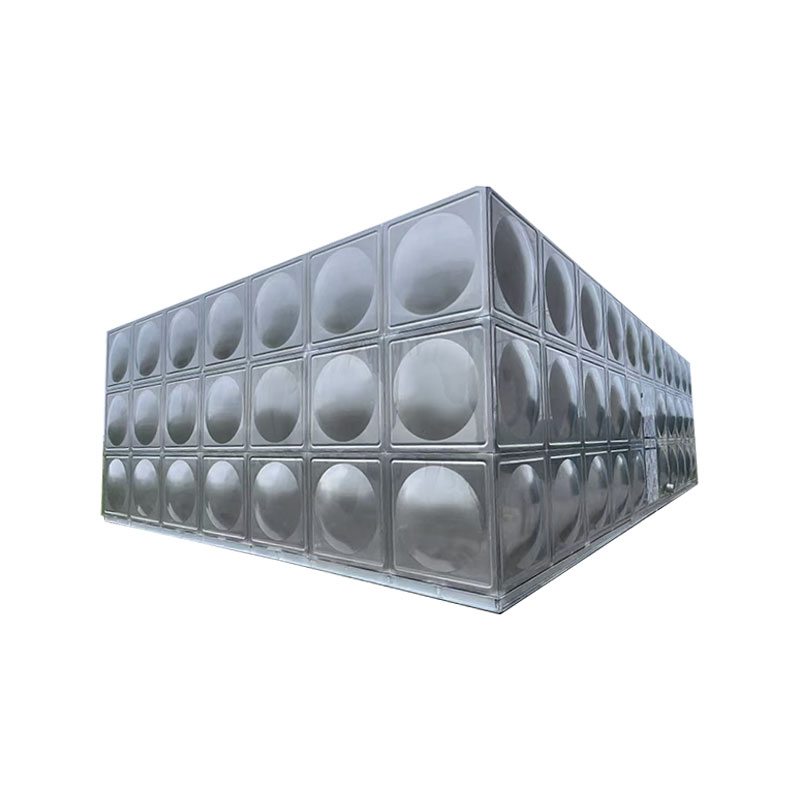
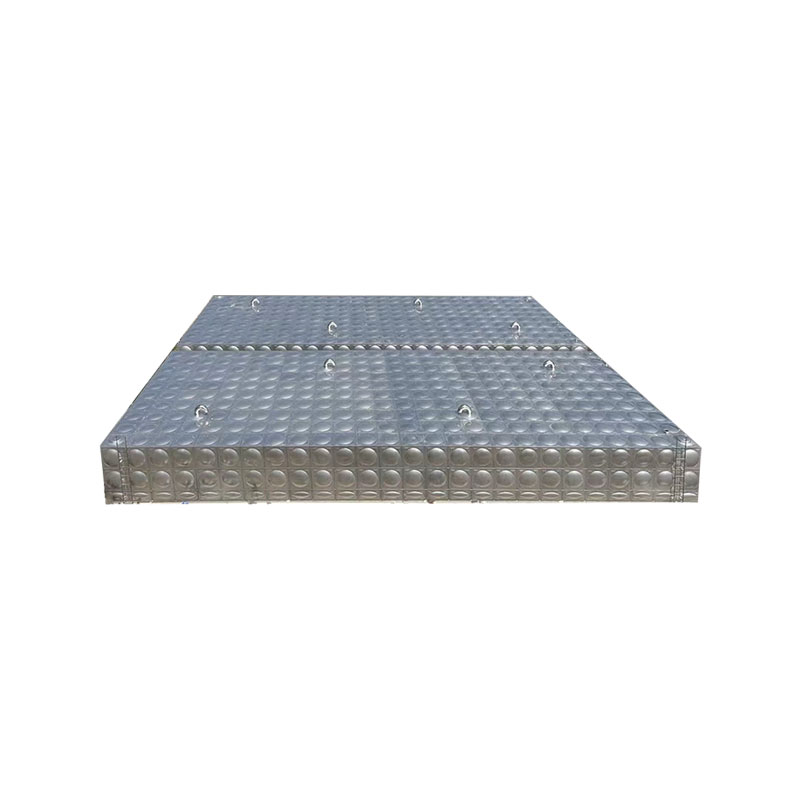
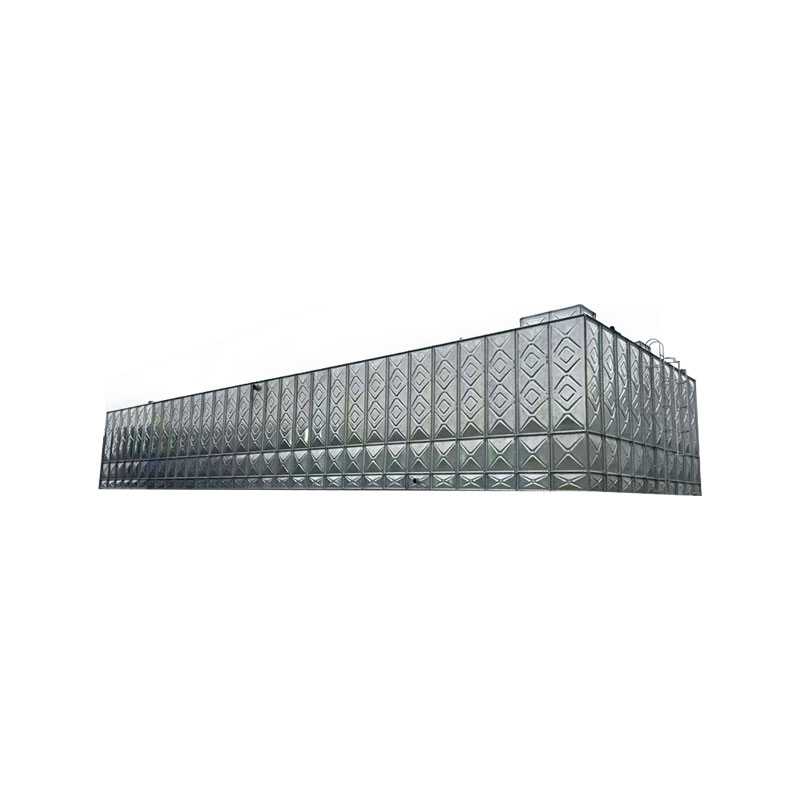
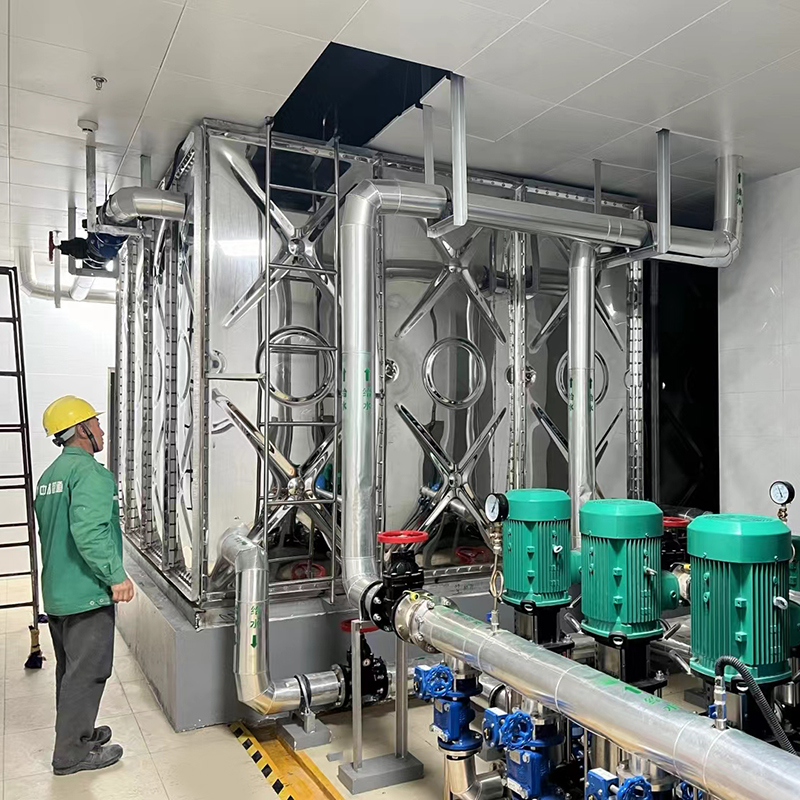
A sectional water tank is a modular storage tank constructed from pre-fabricated flat panels that are bolted together on-site to form a complete, watertight vessel. Unlike a monolithic tank that must be manufactured at its full size and delivered in one piece, a sectional tank is shipped in panels that can pass through standard doorways, hatches, and access routes — making it the preferred choice for installations inside existing buildings, plant rooms, roof spaces, and basements where access is restricted.
How Sectional Tanks Are Constructed
Panels are typically 500 mm × 500 mm, 1,000 mm × 1,000 mm, or 1,000 mm × 500 mm depending on the manufacturer. Each panel is bolted to adjacent panels using stainless steel or galvanised bolts, with food-grade EPDM or silicone rubber gaskets at every joint to ensure a watertight seal. Internal tie rods or a structural framework resist hydrostatic pressure from the stored water. The base sits on a reinforced concrete plinth or galvanised steel frame supplied as part of the system.
A 5,000-litre sectional tank typically measures approximately 2.0 m × 2.5 m × 1.0 m (L × W × H) or equivalent configuration depending on the panel module chosen, making it compact enough for most plant rooms.
Key Advantages of Sectional Water Tanks
- Access through standard openings — Panels typically pass through a 600 mm × 600 mm access hatch, resolving the single biggest installation challenge for large-volume storage.
- Unlimited scalability — Capacity can be increased later by adding panels to extend the tank length or height, without replacing the existing structure.
- On-site sizing flexibility — The tank footprint and height can be configured to match the available space precisely, rather than being constrained to standard sizes.
- In-situ repairability — Individual damaged or corroded panels can be replaced without decommissioning the entire tank.
- Compliance with UK water regulations — Quality sectional tanks are manufactured to WRAS (Water Regulations Advisory Scheme) approval requirements, confirming materials are safe for potable water contact.
Stainless Steel Sectional Water Tank: Why Material Choice Matters
Sectional water tanks are manufactured in three primary materials: GRP (glass-reinforced plastic / fibreglass), food-grade polyethylene (PE), and stainless steel. Each has its place, but stainless steel sectional water tanks are the benchmark choice for long-term, high-quality potable water storage in commercial, industrial, and critical infrastructure applications.
Stainless Steel Grades Used in Water Tanks
The two most common grades are:
- Grade 304 (18/8 stainless) — The standard grade for potable water storage. Contains 18% chromium and 8% nickel. Suitable for most water storage applications where chloride levels in the water or environment are low to moderate. The most widely used grade for sectional cold water tanks in the UK and globally.
- Grade 316 (marine grade) — Contains an additional 2–3% molybdenum, giving superior resistance to chloride-induced pitting corrosion. Specified for coastal installations, applications using treated or chemically dosed water, and any site where the stored water has elevated chloride content above approximately 200 mg/L.
Panel thickness is typically 1.2 mm to 2.0 mm depending on tank height and the hydrostatic load each panel bears. Lower panels in a tall tank are specified at greater thickness than upper panels.
Advantages of Stainless Steel Over GRP and PE
Table 2: Stainless Steel vs. GRP vs. PE Sectional Tanks — Key Property Comparison
| Property |
Stainless Steel |
GRP (Fibreglass) |
Polyethylene (PE) |
| Typical service life |
25–50+ years |
20–30 years |
10–20 years |
| Potable water approval (WRAS) |
Yes |
Yes (approved grades) |
Yes (food-grade PE only) |
| Algae / biofilm resistance |
Excellent (smooth surface) |
Moderate (surface degrades) |
Moderate |
| UV resistance |
Excellent |
Good (gel-coat protected) |
Poor without additives |
| Fire resistance |
Non-combustible |
Combustible |
Combustible |
| Impact resistance |
Very high |
Moderate (brittle at joints) |
High (flexible) |
| Temperature resistance |
Up to 300°C+ |
Up to ~80°C |
Up to ~60°C |
| Recyclability |
100% recyclable |
Difficult to recycle |
Recyclable |
| Relative cost (installed) |
Higher upfront |
Mid-range |
Lower upfront |
The higher upfront cost of a stainless steel sectional water tank is consistently justified by its lifecycle economics. A stainless tank lasting 40 years at a cost of £4,000 installed represents a lifecycle cost of £100/year. A PE tank at £1,500 lasting 12 years requires replacement twice in the same period, totalling £3,000+ with additional installation costs — approaching or exceeding the stainless option with inferior water quality outcomes throughout.
Sizing and Configuring a 5,000 Litre Sectional Tank
One of the most practical benefits of a sectional water tank is configuration flexibility. Unlike a moulded tank, the dimensions of a sectional tank can be adjusted to fit your available footprint and height restriction, while still achieving the target 5,000-litre capacity.
Common 5,000-Litre Sectional Tank Configurations
Table 3: Example Configurations for a 5,000-Litre Sectional Water Tank (based on 1 m × 1 m panels)
| Length |
Width |
Height |
Approx. Capacity |
Best For |
| 2.5 m |
2.0 m |
1.0 m |
5,000 L |
Low ceiling plant rooms |
| 2.5 m |
1.0 m |
2.0 m |
5,000 L |
Narrow corridor or plant room |
| 2.0 m |
2.0 m |
1.25 m |
5,000 L |
Square footprint spaces |
| 5.0 m |
1.0 m |
1.0 m |
5,000 L |
Long, narrow spaces |
Always allow a minimum clearance of 500 mm on at least one side and the top of the tank for inspection, maintenance, and access hatch operation per HSG274 (Legionella) and WRAS guidance. A tank pushed hard against walls with no maintenance access will fail compliance inspections.
Regulatory Compliance and Standards for Sectional Cold Water Tanks
In the UK and many international jurisdictions, cold water storage tanks — especially potable water break tanks — must comply with a defined framework of standards. Non-compliant installations risk enforcement action, insurance voidance, and — most critically — public health risk from Legionella or chemical contamination.
Key UK Standards and Regulations
- Water Supply (Water Fittings) Regulations 1999 — Requires that all materials in contact with wholesome water are WRAS-approved and do not contaminate or waste water. Stainless steel tanks meeting BS 4994 or BS EN 13280 satisfy this requirement.
- BS EN 13280:2001 — European standard specifically for GRP cold water cisterns. For stainless steel tanks, manufacturers typically reference BS 1564 (pressed steel cisterns) or material-specific standards plus WRAS Product Approval.
- HSG274 Part 2 (HSE) — The Health and Safety Executive's technical guidance on controlling Legionella in hot and cold water systems. Requires cold water storage tanks to be insulated, covered, screened against light, and maintained at temperatures below 20°C throughout.
- BS 6700 / BS EN 806 — Specification for design and installation of cold water services in buildings. Guides sizing, overflow design, warning pipe requirements, and tank positioning.
- L8 ACoP (Approved Code of Practice) — Legionella control obligations for duty holders including risk assessment, written scheme, and inspection records for all cold water storage tanks.
Mandatory Tank Features for Compliance
- Close-fitting, vermin-proof lid with insect mesh on all vents and overflow outlets.
- Insulated walls, base, and lid to prevent temperature rise above 20°C (Legionella growth threshold).
- Sealed warning/overflow pipe discharging to a visible, safe location.
- Screened inlet float valve to prevent backflow contamination.
- Access hatch of sufficient size for internal inspection (minimum 450 mm × 450 mm per HSG274).
- All penetrations sealed to prevent ingress of light, dust, and insects.
Installation Process for a Sectional Water Tank
A correctly installed sectional water tank is a straightforward project for a competent plumbing or water system contractor. The key difference from single-piece tank installation is that all assembly work happens in the final location, removing transport and access constraints entirely.
- Site survey and structural assessment — Confirm the floor can carry the loaded tank weight. A 5,000-litre stainless steel tank weighs approximately 5,200–5,400 kg when full (water = 1 kg/litre + tank weight ~200–400 kg). Structural calculations may be required for upper-floor or roof installations.
- Base frame or plinth preparation — A level galvanised steel support frame or reinforced concrete plinth is installed. The frame must be level to within ±2 mm across its full length to ensure panel joints remain tight under load.
- Panel delivery and transportation to installation point — Individual panels are typically 1 m × 1 m and weigh 10–25 kg each — easily manoeuvred through corridors and up stairwells by two people.
- Panel assembly — Base panels are laid first, then side, end, and top panels are progressively bolted together. EPDM gaskets are installed on each joint face before bolting. All bolts are tightened in a cross-pattern sequence to ensure even gasket compression.
- Internal tie rod installation — Horizontal tie rods are installed at specified heights to resist outward hydrostatic pressure on the side panels.
- Pipework connections — Inlet (with float valve), outlet, overflow/warning pipe, and drain valve connections are made through pre-punched or site-drilled penetrations with tank connectors and WRAS-approved fittings.
- Insulation and lid fitting — Insulation boards are applied to external walls, base, and lid. The insulated lid is fitted with a hinged access hatch and insect mesh on all openings.
- Water test and commissioning — Tank is filled, all joints checked for leaks, float valve set to correct shut-off level (typically 75–80% of tank depth to provide reserve capacity), and system documented for the building's water risk assessment record.
Total installation time for a 5,000-litre sectional tank by an experienced two-person team is typically 4 to 8 hours excluding pipework connections, depending on configuration complexity and access conditions.
Maintenance Requirements to Maximise Tank Life and Water Quality
A stainless steel sectional water tank requires relatively minimal maintenance compared to GRP or PE alternatives — but maintenance cannot be skipped without regulatory and health consequences. The HSE's L8 ACoP and HSG274 make clear that stored cold water must be subject to a documented maintenance regime.
Recommended Maintenance Schedule
Table 4: Maintenance Schedule for a Cold Water Sectional Storage Tank
| Frequency |
Task |
Compliance Reference |
| Monthly |
Check cold water temperature at draw-off; must be ≤20°C |
HSG274 / L8 ACoP |
| Monthly |
Inspect float valve operation and overflow pipe |
Water Fittings Regs 1999 |
| 6-monthly |
External visual inspection: insulation, lid, seals, pipework |
HSG274 Part 2 |
| Annually |
Internal inspection: sediment, biofilm, panel joint condition, tie rods |
L8 ACoP |
| Annually |
Tank clean and disinfection per BS 8558 / chlorination to 50 mg/L, 1-hour contact time |
BS 8558 / HSG274 |
| As required |
Re-torque panel bolts if any leakage at joints is observed |
Manufacturer guidance |
| Every 5–10 years |
Replace EPDM gaskets if any signs of compression set or micro-leakage |
Manufacturer guidance |
The smooth, non-porous surface of Grade 304 or 316 stainless steel significantly inhibits biofilm attachment compared to GRP, which develops surface crazing over time that harbours microbial growth. This makes the annual cleaning task faster and more reliably thorough on a stainless tank — a meaningful practical advantage in Legionella risk management.
Cost Guide: What Does a 5,000 Litre Stainless Steel Sectional Tank Cost?
Pricing varies significantly by manufacturer, grade of steel, panel configuration, and whether insulation, a base frame, and pipework connections are included. The following ranges are indicative for the UK market (2024 figures) and should be verified with current supplier quotes.
- 5,000-litre Grade 304 stainless steel sectional tank (supply only, no insulation): £2,500–£4,500 depending on panel count and configuration.
- With insulation, insulated lid, and base frame package: add £400–£900 to the above.
- Grade 316 upgrade premium: typically 15–25% more than Grade 304 equivalent.
- Installation labour (2-person team, 1 day including pipework connections): £600–£1,200 depending on region and complexity.
- Fully installed and commissioned total cost: £4,000–£7,500 for a standard plant room installation.
Compared to a GRP equivalent at approximately £1,800–£3,200 installed, the stainless steel premium is real but modest when spread across a service life of 40 years. For most commercial and critical infrastructure applications, the stainless steel option delivers superior whole-life value, lower maintenance cost, and reduced compliance risk.
Choosing the Right Tank: Decision Summary
Use the following decision logic to confirm whether a 5,000-litre stainless steel sectional water tank is the right solution for your situation:
- You need potable cold water storage with WRAS compliance and a service life exceeding 20 years → Stainless steel sectional tank.
- Your installation site has restricted access that prevents a one-piece tank being delivered → Sectional tank of any material; stainless preferred for longevity.
- You may need to increase capacity in the future without a full replacement → Sectional tank (any material) — add panels to expand.
- Your site is coastal, or the stored water has elevated chloride content → Grade 316 stainless steel sectional tank.
- Budget is the primary constraint and the application is non-potable or temporary → GRP or PE sectional tank is acceptable.
- Your daily demand is between 500 and 2,500 litres → 5,000 litres provides a 2–10 day buffer, which is appropriate for most residential and light commercial applications.
A 5,000-litre stainless steel sectional water tank represents the most durable, compliant, and scalable cold water storage solution available for buildings and sites where access, longevity, and water quality are all priorities. Sized correctly to your actual demand, installed to current regulations, and maintained on schedule, it will serve reliably for decades with minimal intervention.



 Tiếng Việt
 عربى
عربى Get a quote

 Tel: +86 0515-86302568
  E-mail:
  Add: No. 11, Xingwang Road, Jianyang Town, Jianhu County, Jiangsu Province, China